Monday, March 30, 2015

Atherton Homes is doing its part to help conserve water....

Have a look at the latest watering guidelines from the City of Manteca.

Tuesday, January 6, 2015

Housing affordability crisis drives Bay Area middle-class exodus

San Francisco Business Times


Seana O'Shaughnessy has lived in the Bay
Area for 19 years — nearly half her life. Yet in the next few months,
O'Shaughnessy, 41, and her husband will pack up and leave Redwood City
for Chico in time for her daughter to start kindergarten in the fall. It
breaks her heart, but O'Shaughnessy believes she has no choice.


"I love the Bay
Area. I love the community, culture, diversity, opportunities. I love
the access to the ocean, mountains and San Francisco. It is such an
amazing city," she said. "But it's gotten a little crazy right now. We
decided we didn't want to be slaves to our house and have nothing else."


Ironically,
O'Shaughnessy has had a ringside seat for the affordability struggles
that eventually priced her out of the Bay Area. She serves as the
executive director of Rebuilding Together Peninsula, a nonprofit focused
on building volunteer partnerships to rehabilitate homes and community
facilities for low-income families and individuals, and was honored by
the Housing Leadership Council of San Mateo for her efforts.


In Chico, O'Shaughnessy and her husband – who also works for a nonprofit – can much more comfortably afford a home.


"The homes are
probably 60 to 70 percent less expensive there," she said. "We have been
renting and looking at buying a home around the Peninsula, but with the
prices, we just couldn't justify it. Combined, we ought to be able to
afford a house based upon statistics – but statistics don't take into
account things like the cost of child care and student loans."


O'Shaughnessy and
her husband are examples of a growing population of people who can
simply no longer afford to live comfortably in the Bay Area.


"It's a crisis," she said.


No end in sight


Despite growing
alarm and a widening recognition that the region's mismatch between
supply and demand in housing is an increasingly severe problem, there
are few signs of change. The city of San Francisco is still producing
only 2,000 housing units per year — when it has needed more like 5,000
for the last 20 years and going forward.


Only 14 percent of
households in San Francisco can afford the median-priced home, which was
$999,250 in October, the lowest such percentage of any metropolitan
area in the country, according to a study by Trulia.


The median price of a
house in the nine-county Bay Area was $601,000. Areas such as Oakland —
where 40 percent of households can afford the median price — and San
Jose — where 34 percent of households can afford the median price — had
more affordable homes than San Francisco. But the mismatch in housing
and job production virtually ensures prices aren't going to move down.
The Bay Area generated 114,000 net new jobs last year — and only 8,000
units of housing. Meanwhile, there's still a backlash in some suburban
communities at policy initiatives designed to encourage or require them
to produce more housing.


Renting is no
cheaper, with median monthly rents for a one-bedroom apartment at $3,200
in San Francisco — higher than New York. Seven of the 10 U.S. cities
with the highest rents are in the Bay Area.


Employers worried


The region's housing
mismatch increasingly affects hiring and corporate location decisions.
In early 2014, Charles Schwab Corp. told employees in San Francisco that
it planned to move "a significant number of San Francisco-based jobs"
to other locations around the country over the next three to five years.
The move is expected to involve more than 1,000 of its Bay Area
workforce of 2,700.


Sarah Bulgatz,
director of public relations for Charles Schwab, in November 2014
confirmed that the company made the decision several years ago to focus
outside of San Francisco for future growth, due to factors "including
the high cost of living as well as the high cost of doing business."


While San Francisco remains the company's corporate headquarters, she said Phoenix is now its largest single employment base.


For Molly Dick,
founder of San Francisco-based Crossroads Relocation Services, it's a
familiar story. Dick specializes in helping companies move offices or
executives and she's seen her client base shrink. Fewer companies, she
said, are willing to invest in her services when many prospective
employees are scared off by housing costs and turning down jobs.


"They basically say
they can't afford to throw money at candidates who don't end up taking a
job," said Dick, relating the tale of recently assisting a client with
the recruitment of a CEO candidate from outside the area.


"They had two school-age children
and a budget of $1.5 million to $1.7 million and could put a significant
amount down," she said. "At the end of the weekend, they decided they
were not going to do it. While the city will always have appeal, there
are other factors involved and I'm definitely seeing a growing
disillusionment compared to decades past.


"With soaring real
estate prices and surging population growth, we are in a bubble. You're
seeing primarily overseas buyers and wealthy new tech workers," she
said. "So where does that leave the relocating executive and his family
who often can't sell their homes in a languishing market elsewhere? Most
of them don't know how they will afford the quality of life here."


Sean Randolph,
president and CEO of the Bay Area Council Economic Institute, said the
area's housing problem is "the accumulation of decades of
underbuilding."


"There's been a lack
of development of housing at all income levels," he said. "I came here
in the late 1990s and even then it was very clear that there had been a
failure to keep up with demand going back at least 10 years before
that."


Unfortunately, Randolph doesn't foresee a letup in the housing pressure anytime soon.


"There's been a lot
of resistance throughout the Bay Area of development of any kind, but we
have to get real about the implications of failing to put housing into
place," he said.


SPUR Executive
Director Gabriel Metcalf, and a longtime commentator on housing said
that San Francisco residents' resistance to homebuilding is at odds with
the city's professed progressivism.


"It does not make
sense that you can think of yourself as progressive, but still think
it's OK to not allow people to come here, which is the real-world impact
of our longtime emphasis on protecting the physical character of the
city from change," Metcalf said. "Ultimately, when supply is constrained
and demand increases, people with more money win. Many of the people
that made this city colorful and interesting are leaving or have already
left."


Overall, there is
growing concern that the city of San Francisco – and the Bay Area as a
whole – is turning into a region of elites, one being hollowed of its
middle-class and middle-aged residents, particularly those with
families.


Metcalf last year
authored a widely read blog post on the exodus from San Francisco in
particular. "My friends keep moving to Oakland," it began.


Hard sell to execs to relocate


Betty Granoff,
president of San Francisco-based Relocation Breakthroughs, works with
individuals who have been asked to relocate or are considering a new job
in the Bay Area.


"Usually what
happens when someone contacts me is that their maximum rent is almost
always way low compared to where they want to live," she said. "They are
shocked. Most of the time, those who still can end up changing their
minds."


Those who don't end up having to compromise – a lot.


"I've been doing
this since 1996 and this is the craziest I've seen things," she said.
"Even with the first dot-com boom in the late 1990s, demand was just as
high but rents weren't."


And while San Francisco remains one
of the nation's most powerful magnets for millennials with high-salaried
jobs, those lower down the income scale feel pushed away.


Recent UC Berkeley
graduate Kaitlyn Quackenbush is a Bay Area native who says she may leave
soon. After spending nine months searching for an apartment she could
afford, the 23-year-old ended up disappointed and resentful.


"There's a cultural
shift and cost shift going on and San Francisco just doesn't feel like a
city I want to be in anymore," she said. "It feels a little bit like a
gated community where the middle class and working class are
disappearing."


Sunday, November 16, 2014

Now that’s entertainment!

$779K helps lay foundation for 189-acre ‘family play’ zone


Great Wolf Resort isn’t a done deal.

But that isn’t stopping the city from taking the next step that would not only serve the 500-room resort with an 85,000-square-foot indoor water park but would lay the ground work for a massive 189-acre family entertainment zone also known by the shorthand of FEZ.

The City Council Tuesday is being asked to spend $779,157 from remaining redevelopment agency funds to retain the services of NV5 Inc. The engineering firm will design construction documents for major utility relocation work and expansion plus the extension of Daniels Street to McKinley Avenue.
Development of the FEZ will be accomplished via a public-private partnership. A private sector development group will construct the buildings, sports fields interior roads and “local” wet and dry utilities. The city will relocate and extend major utility lines such as water, sewer, and storm drains. the city also will extend McKinley Avenue.

McWhinney Development — the firm that would build the resort — is currently negotiating with Manteca as environmental studies are being completed for the resort and the rest of the FEZ.
If the Great Wolf Resort is built, it will be the biggest single investment at one time in a private sector project in the history of Manteca coming in at $150 million. Great Wolf would also become the largest private sector employer if and when they open their doors. It would take roughly two years to build and would provide 570 jobs of which 414 would be full-time. The projected annual payroll is $9.4 million.

McWhinney is basing negotiations on a 290,000-square-foot hotel with 500 rooms – with a possible future expansion of 200 rooms – along with an 85,000-square-foot indoor water park and a 20,000-square-foot conference center. A possible expansion would add 79,000 square feet to the water park and double the size of the conference center.

The resort would sit on 30 acres immediately west of Costco fronting the 120 Bypass. It would also include a conference center and community exhibition facilities plus a large public parking lot.
Two additional baseball fields would be added to the west of the Big League Dreams complex. The sports complex would also have a western entrance.

A large manmade lake would go to the west of BLD and north of the Great Wolf site. It would be surrounded by passive and active recreation facilities plus supporting commercial uses. A loop road would circle the lake and connect in three locations with Daniels Street as well as a future extension of Wawona Street that will go along the northern boundary of the BLD complex.

Nine playing fields designed for soccer including three international fields will be created. That is in addition to a playfield designed for soccer with spectator seating.

An indoor sports structure is envisioned along with outdoor speed sports plus areas for various other recreational endeavors.

Ultimately a new visitors center could be build on McKinley Avenue near its future connection with Daniels Street.

Since the FEZ will border the wastewater treatment plant facilities, a major landscape buffer is included.
At the same time two other projects are moving forward that complement the FEZ but are not a part of it. That includes work on creating an interchange on McKinley Avenue at the 120 Bypass and punching Milo Candini Drive through to West Yosemite Avenue.

The council meets at 7 p.m. at the Civic Center, 1001 W. Center St.


Executive Editor
dwyatt@mantecabulletin.com  
209-249-3519
 

Monday, November 3, 2014

Trains ease commute, bolster economy

It was “all aboard” the Altamont Corridor Express Thursday morning for some two dozen Manteca, Lathrop and Ripon community leaders to see for themselves how ACE serves thousands of riders a day on four trains.

ACE plans to expand its service into Stanislaus County in a bid to reduce freeway congestion for Bay Area commuters and boost the Central Valley economy.  They offer people the opportunity to experience commuting via train from the valley to learn more about its operation by offering three gratis passes to anyone just for the asking on their website.

A common thread running between ACE leadership and the communities it services is the “regional economic impact” of the ACE rail system expansion cities in five counties.

The new train station on Moffat Boulevard underscored the interest of Manteca community leaders as they boarded a 7:24 a.m. promotional ACE train to San Jose with their counterparts from Lathrop, Ripon, Modesto, Turlock  and as far away as Stockton and Merced complete with a stop at  the new 49ers Levi Stadium.

The future calls for ACE riders to be boarding at the new Manteca station as well as stations in Ripon, Modesto, Turlock, Livingston and Merced.  The cost of the rail expansion to Modesto of some $200 million is expected to be borne by the three counties most involved with the ridership, Stanislaus, San Joaquin and Santa Clara.

The extension of ACE service to Merced from Modesto is set at $350 million. The addition of the seventh to the tenth train is estimated at another $200 million.

The train averages speeds of 45 miles an hour through the Altamont Pass contrasts with backed up and sometimes stopped commuter traffic on the 580 corridor.  Thursday’s motor vehicles on commute routes were moving at about 10 miles an hour.  The rail line to the west from Manteca was built in the 1850s as a freight line and has required upgrades to handle the ACE passenger traffic.

The route is now heralded as an “easy access” to San Jose, San Jose Airport and to the 49ers Levi’s Stadium for games.  There have been special shopping trains offered in the past, but the lack of interest canceled that effort, according to an ACE spokesman.  A panel of three Manteca area residents spoke telling how they were able to work in the Silicon Valley and still keep up with their responsibilities at home — two with children in school and in sports programs.

The speakers were Jean Hernandez, Marlene Goodall and Marlene Vida.

Students and instructors from Stanford University and San Jose State are being offered a 50 per cent discount with hopes Santa Clara University can soon be added to that list. Senior citizens are also being offered discount rides.

There were also several representatives present from the Councils of Government from both San Joaquin and Stanislaus counties.

A dimly lit “Quiet Car” is offered daily where riders can catch a little extra sleep.  Thursday’s riders from the valley were led to a second level where they could enjoy each other’s company and converse as they chose meeting their counterparts from the other communities.

ACE owns some $70 million in rolling stock in diesel engines and cars along with $76 million in facilities and $113 million in upgraded rail infrastructure.

Riders from Manteca included Realtor Wendy Benevidas who said she and other Realtors routinely boast the availability of ACE to potential home buyers.  Joann Beattie, director of Manteca’s Chamber of Commerce joined the group as did Ripon Chamber President John Mangelos and his Executive Director Tamra Spade.  Manteca Economic Development Director Don Smail was also on hand for the trip and its presentations along with mayoral candidate Ben Cantu. 

Stacy Mortensen, CEO of the ACE train since its inception 15 years ago, spoke before the group in a downtown San Jose conference room said.

“We are at a point that we have to start thinking about a fifth train,” Mortensen said. “We follow what happens in the Silicon Valley — it powers us.”

Mortensen also told of a plan to create a tunnel in the Altamont to speed up trips.

The train allows for computer engineers and others in the high paying technology fields to consider the Valley for lower priced homes bringing those professionals to the cities of Stockton, Manteca, Modesto and hopefully as far south as Merced.  The two-hour trip to and from work allows them more time to work on their ongoing projects using Wi-Fi in some of the cars.  All the ACE cars will soon have the Wi-Fi connections.

“We have great shuttles,” Mortensen said of the connections to work sites after the train trip.  “Some take as much as 40 minute shuttle drives. We have a big partnership with transit groups.  We don’t charge for parking and we don’t charge for the shuttles now.” 

The ACE leader said there are normally some 18 shuttles waiting near the tracks on each train arrival where within two minutes many passengers disappear into the Santa Clara community. The service also connects with BART.  The bulk of the passengers from San Joaquin and Stanislaus counties are going all the way to San Jose, she said.

There is a drop off of passengers in Pleasanton making room for new riders boarding at that station on their way to San Jose.  When passengers arrive at their destination in San Jose there is always an ACE employee identified by his hat who directs riders unsure of just where to go from the terminal.

A recent survey of ACE riders indicated that nearly 37 percent of them brought their work with them so they could best use the time on the train.  Others told of making business calls on their cell phones and commuting through use of their email and their laptop computers.

The study also indicated that ACE riders, who work while they are on board, represent a collec-tive value of their work time at $12.5 million.  Current on savings of commuting costs came in at $11.8 million annually. 

Expansion projects to increase the reliability of ACE include the upgrading of new and upgraded siding, track realignment and the building of new rail connections in planned stages with service targeted to extend to Modesto by 2020.  With the launching of service to Modesto two additional trains will be added to the system.  Extension of service to Merced is slated for 2025 with an increase to 10 weekly daily trains.

Service is also expected to be extended to the weekends with the earlier operation of six trains.


Reporter 
gkahl@mantecabulletin.com

Thursday, October 23, 2014

They're Going Fast...

Having sold over a half-dozen homes in the past 3 weeks, Union Ranch - Unit 5  is down to its final 5 lots.  Stop by our Sales Office today and inquire about Close Out specials for the remaining lots.  

Atherton Homes - Sales Office
2517 Edgebrook Lane
Manteca, CA 95336
209-824-2071

Saturday, August 16, 2014

Inventory Special!

Looking for a new home in Manteca? We've got just the one for you!

Large Greatroom and Lanai areas are perfect for entertaining. Spacious bedrooms and a 2 1/2 car garage located in quiet upscale community. Stop by our Sales Office for more information today!


Saturday, July 5, 2014

ONE SWEET LIFE

Atherton helps shape economies in Manteca, Hawaii & Nicaragua

Executive Editor

“Coach” is still swinging for the bleachers.

These days, though, that entails Mike Atherton playing right field on a softball team in Maui while he oversees a coffee plantation, a popular Maui agri-tourism operation, and one of only two major community developments to get the blessing of county authorities in Hawaii to build homes and commercial.

Atherton has been called “Coach” for years. It’s a nod to his forte as a playmaker on teams that he has assembled for everything from tearing down the shuttered Spreckels Sugar factory and converting it into an economic juggernaut that spurred 21st century job growth in Manteca, building a school and homes for coffee plantation workers in Nicaragua or converting an old 2,000-acre sugar cane plantation into small farms, an agri-tourism destination, and a new community.

Atherton is the first to tell you the successes he has been involved with — everything from getting development rolling south of the 120 Bypass, Spreckels Park, the creation of bonus bucks in Manteca, laying the groundwork for Del Webb at Woodbridge and the Promenade Shops at Orchard Valley and even getting Great Wolf Resorts to take a look at Manteca — are team efforts. While he brings savvy, passion, and vision to the table his various partners in ventures ranging from Bill Filios, Al Boyce, Bing Kirk, and Toni Raymus among others bring equally important skill sets such as business acumen, attention to details, a love of their community, and a desire to do more than just build homes and business/industrial parks. Call it a desire to leave a legacy by building a community.

Atherton has been in Hawaii for five years. It is where he and partners launched Coffees of Hawaii, growing coffee on six islands and buying farmland on Molokai.

He found himself in his element.

“I’m a storyteller,” Atherton said.

He put that skill set to work talking the ears off tourists — including a number from Manteca — that make their way to his Molokai farm to satisfy their curiosity about everything from taro to sugar cane. But he soon found not a lot of tourists made their way to Molokai.

So when the opportunity came up to purchase the Waikapu sugar plantation, Atherton convinced his partners it was a great opportunity.

It was shortly thereafter that Atherton discovered that while it is challenging to develop in California it is a downright daunting task to do so in paradise.

Atherton envisioned a  project that preserved producing agricultural land, created an agri-tourism element, and provided 1,500 homes in a self-sustained community.

When he first rolled out the plan, the County of Maui gave him a clear thumb down. The motion to approve the project didn’t even garner a second.

“It was the first time I ever was told no for a project,” Atherton said.

On top of that — to paraphrase a favorite Atherton line — the sun stopped shining making it impossible to make hay as the global housing market collapsed.

That was when Atherton started deploying development strategies that helped lay the groundwork for an ongoing successful 35-year run in Manteca. He offered to give more for community endeavors than what development rules required. He tweaked the project to reflect local values and to provide the basis for sustainability for generations to come.

When the dust had settled, of the 20 projects vying to secure county approval in Maui only two survived — Atherton’s master planned Waikapu country town coupled with a prime farmland agricultural preserve and a development advanced by the iconic Hawaiian firm of Alexander Baldwin.

To date, local farmers are growing crops such as mangos, taro, avocado, bananas and coconuts on 1,000 acres of prime agricultural land. There’s tourists visiting what was once one of Hawaii’s premier sugar plantations, and the initial phases of a self-sustained community have been put in  place including solar farms and wind power generators to provide all the energy needed.

Following in Claus

Spreckels’ footsteps

Atherton’s venture in Maui has a definite Manteca connection — Claus Spreckels.

The Manteca sugar plant that AKF Development would later tear down and replace with a multi-use project generating close to 2,000 jobs  was built in 1916 by Spreckels. Atherton and his partners bought the Waikapu sugar plantation that was originally founded by Spreckels several years after he established his Manteca plant.

“The factory was almost identical to the one in Manteca,” Atherton noted. “It was designed by the same guy.”

Atherton has impressed natives and local history buffs with his knowledge of Claus Spreckels and his sugar empire. They often asked how he became some versed in the subject.

“I learned it all in Manteca is what I tell them,” Atherton said.

He’s the man for whom Atherton drive in South Manteca is named. The road is destined to become the community’s most heavily traveled thoroughfare as the 1,049-acre Austin Road Business park develops along with commercial fronting the 120 Bypass. Atherton followed in the footsteps of other famous men — his grandfather and his great-grandfather.

Great-grandfather Benjamin Holt revolutionized farming and land development when he invented the Caterpillar in Stockton in the 19th century. The machine’s first big tests included transforming tens of thousands of acres in the San Joaquin Valley into fertile farmland and the development of the Delta’s levee system.

Grandfather Warren Atherton was the national commander of the American Legion who created and successfully lobbied to get Congress to adopt the GI Bill assuring those who served America of being able to get a college education.

Atherton said sometimes he tries to figure out which had a bigger impact on America — the invention of the caterpillar or the GI Bill.

“It’s an interesting debate,” he said.

His father Warren Atherton II was a lawyer who passed away at age 49.

Atherton picked up his passion for building communities from his uncle Sandy Atherton who was the developer of the 7,000-acre Lincoln Village area in Stockton.

Manteca is

Atherton’s home

Atherton, 65, is in Manteca for a spell.

He has business interests here including Atherton Homes and a piece of other ongoing endeavors including Austin Road Business Park. He has a home here and his son lives here.

His Manteca home is a tad more traditional than his accommodations on Maui where he lives in a converted double decker bus.

“Hawaii is the most beautiful place in the world next to Manteca,” Atherton said.

 Those aren’t words of a salesman. Instead they are from a man who takes pride at what he and his partners have helped bring to Manteca and one who sees even greater things on the horizon for the community.

“My plan is when I’m through in Hawaii is to come back here and help finish things up,” Atherton said.

Atherton was the key linchpin to convince others to put their fortunes on the line to demolish the sugar refinery and develop Spreckels Park. Banks wouldn’t touch it. Other developers feared possible “hidden” pitfalls such as toxic issues and the daunting task of demolishing a factory, tearing down four 15-story concrete silos, and rehabilitating the land include the equivalent of 75 years worth of lime use for county agriculture.

The abandoned factory was at the most high profile intersection in Manteca — the Highway 99 and 120 Bypass. And as such it posed the potential of being a cancerous blight that could severely limit economic growth in Manteca.

At one point the partnership teetered on bankruptcy with cash dwindling down to a week’s supply at best until a deal was closed for the sale of the 177-lot Curran Grove neighborhood where factory housing and an almond orchard once stood.

Atherton flees

the Sandinistas

Atherton’s road to Manteca included cutting his teeth as a farmer and community builder in Nicaragua.

Atherton while in his 30s, said a college friend who was a Peace Corps worker urged him to go to Nicaragua for two weeks. If he didn’t like it, the friend said he’d at least get a vacation.

Atherton ended up investing five years developing raw land in the Central American country into productive farms as well as building villages.

He eventually got Bing Kirk —  who was a partner with him and Filios in the development of Spreckels Park— to join him for several years.

“One day the workers came to me and said ‘Mike there’s going to be a war and we don’t want you to get hurt. You have two weeks to leave,,” Atherton once recalled.

Atherton escaped Nicaragua in 1979 before the Sandinistas overthrew the government in a bloody war.

Atherton returned to San Joaquin County. He eventually returned to Nicaragua and founded the Jesus Mountain Coffee Plantation that is operated in tandem with Coffees of Hawaii coffee plantations.

Atherton who was born in Stockton and graduated from Stagg High was the front man — development jargon for the managing partner who puts together deals— for a variety of partnerships that at one time represented the bulk of future urban land in both north and south Manteca.

Manteca’s darkest hour

It was Atherton who stepped up to the plate in what was arguably Manteca’s darkest hour in 1997 when Spreckels Sugar was getting ready to shutter the beet processing plant that for generations was an economic mainstay of the community. There were 225 permanent jobs at stake plus dozens of seasonal jobs.

Consulting engineer Ron Cheek approached Atherton about Spreckels company representatives who were looking for a development partner for the 365-acre sugar plant site.

Spreckels Sugar’s original plan had involved leaving the factory and silos intact while surrounding it with 600 to 800 homes, developing commercial along Moffat and a 9-hole golf course with business park uses along Highway 99.

They soon realized it couldn’t work with the factory still there. The Spreckels Sugar corporate hierarchy originally thought it would be a matter of developing the land while shuttering the plant for awhile waiting for sugar fortunes to improve.

But that wasn’t going to happen. Increasing costs for sugar beet growing in California and tougher air quality standards coupled with stiff competition overseas and in the South made a sugar refinery an uneconomic proposition. Holly Sugar in Tracy — the county’s last hold-out — succumbed to the economics nine years ago as well.

There was another problem. No one wanted to develop the property in conjunction with Spreckels with the sugar factory still there and none — including Spreckels — thought that it could be removed without busting the proverbial bank.

So Atherton — with no experience developing an industrial park or commercial ventures — forged ahead. He took a vision to the sugar corporation and put together a partnership that was able to marry private capital with redevelopment agency funds — primarily loans of $5 million that were just paid back in full over five years ahead of schedule — to put in infrastructure necessary to attract commercial users and employers.

But before RDA could add muscle, the factory had to be cleared.

Sweet deal

Atherton found ways to make the clean-up and demolition pencil out.

Soil testing alone searching for contaminates would push the $1 million mark.

Atherton found innovative ways to make the deal work. The four 15-story silos that were imploded before 10,000 onlookers created a mountain of concrete that was crushed and used for road base for what Atherton calls “the sweetest stretch of freeway in California” when Highway 99 was widened from four to six lanes between Manteca and Ripon.

An Oakland salvage company bought the iron. Bricks from the nearly 80-year-old warehouse were recycled. Many were sold but some made their way into projects around Manteca — the front of the now shuttered Kelley Brothers Brewing Co. & Brickyard Oven Restaurant, traffic islands and monument signs in Spreckels Park and the Spreckels Sugar historical plaza developed by AKF for $200,000 behind the Chevron gas station at Yosemite and Spreckels avenues.

Altogether, 98 percent of the factory and silos were recycled. It was such an impressive revitalization effort that Spreckels Park garnered several state awards.

Start in building

Atherton’s first venture into home building took place in Manteca.

He bought acreage on the north side of Louise Avenue west of the Highway 99 freeway back in the days when the interest rate was pushing 20 percent.

Raymus had everything on the south of Louise Avenue. Atherton said they got land north of Louise and west of Highway 99 because no one else wanted it.

Atherton started a home construction venture with his partners. Just like in Nicaragua learning the ins and outs of land development and farming, Atherton immersed himself in all details of the construction business right down to doing the final walk through.

The first year they sold six homes(in Springtime Estates and Raymus sold 60 across the street.

“I asked Antone Raymus what I was doing wrong,” Atherton recalled in an interview eight years ago. “He told me, ‘son, you’ve got to make a few changes’, and then proceeded to delineate all of the insights he had gleaned in nearly 35 years of home building at that time.”

Atherton’s admiration for Raymus runs deep. He looks at what Raymus has contributed to the community as well as solid business decisions to emulate.

He also learned another lesson the hard way — greed is not a good thing.

During the go-go days of the late 1980s and early 1990s, AKF got a bit too aggressive and when the downward slide of 1991 hit, he was one of those builders that came precariously close to the edge because they kept building inventory like there was no tomorrow.

Since then Atherton monitors market trends much closer and does get ahead of the curve. As a result, you will rarely see Atherton Homes with standing inventory.

Working deals

Atherton’s ability to juggle deals and make them work gained a lot of attention in Manteca.

The Woodward Park deal — still the best developer offer ever accepted by the city with  52 acres for $1 and no strings attached — back in 1988 rates as a visionary move even though it has taken the city 15 years to finally get to the point they can do visible development.

Atherton didn’t ask to be exempted from park fees in exchange for the land. In fact, he was among a handful of developers leading the charge 12 years ago to significantly raise park fees. He went a step further and argued they didn’t raise them enough after jumping them more than $1,300 per home.

All of his “deals” hinge on building toward the future with the bottom line being doing the best now means higher returns down the road.

Ask him about Atherton Drive as it has developed around Airport Way and he’ll literally bristle.

He has no kind words for developers who do the minimum and then check out of Manteca.

The portions he developed of Atherton Dive have lush landscaping and bike paths, something that he put in place before the city adopted such standards. In fact, Atherton and his partners drove today’s Manteca landscaping standards.

That is in stark contrast to Atherton Drive near Airport Way where it is asphalt curb to curb with cement sidewalks pushed up against block sound walls.

Roots run deep

Atherton’s ties to San Joaquin County run deep.

His great-grandfather Holt came to Stockton from New Hampshire in 1849

A wagon wheel maker by trade, Holt figured that there would be a huge demand for his product from the men heading toward the gold mines.

After the Gold Rush, Holt turned his attention to the potential of the great Central Valley. It didn’t take long to see traditional farming implements were cumbersome and getting stuck in the valley soil.

So the inventor in Holt — who created 35 different agricultural implements in his lifetime —rolled out a product that would revolutionize farming, land development and even modern warfare worldwide — the Caterpillar tractor.

The tracks distributed the weight of the farm equipment. Holt Manufacturing started turning out Caterpillar products from its Stockton factories.

Atherton’s grandfather —Warren Atherton — married Holt’s daughter Anne. A lawyer by trade, Warren Atherton entered the Holt family concern.

Holt was the inventor and Warren Atherton was the businessman.

Warren Atherton answered the call to duty in World War I and so did Holt Manufacturing. They literally invented the tank by taking a tractor and mounting a gun on top of it to end the reliance on trench warfare. Holt Manufacturing innovations were prevalent on the battlefields throughout World War II.

The Holt Manufacturing plants were shifted to Peoria, Ill. to be more central to the United States markets and closer to the Atlantic where many of the military equipment needs were being shipped to Europe.

After Warren Atherton’s stint in Europe, he was the driving force behind the creation of the G.I. Bill that provided millions of returning servicemen the opportunity to access higher education. His significant contribution to increasing the standard of living of millions through education resulted in Delta College naming its performing arts auditorium in his honor.

His own course

Atherton is a 1967 graduate of Stockton’s Stagg High.

“About the worst thing you had back then in Stockton was fights,” Atherton once recalled. “Stagg was a rah, rah school back then. It was a different time.”

Atherton went off to San Jose State where he pursued political science studies.

Atherton was hanging out around Lake Tahoe after graduation when his friend who had served in the Peace Corps asked him to join him in Nicaragua.

Back in Nicaragua

It is because of the five years that he spent there, that Atherton came up with the idea to enter the coffee business.

Atherton and partners purchased a coffee plantation, rebuilt the farm town — including church and school —  where most of the 75 permanent workers live. The partnership also hires 400 seasonal workers to pick coffee beans.
 

Monday, June 16, 2014

Location, Location, Location...

200-year flood threatens 30,000 Manteca, Lathrop, WR area residents

By Dennis Wyatt - Managing Editor

All of Lathrop west of Interstate 5 and east of the San Joaquin River, every dwelling in Weston Ranch as well as southwest Manteca neighborhoods could end up under upwards of 10 feet of water in the event of a major flood rated as a 200-year occurrence.
More than 30,000 people would be forced to flee to higher ground including the entire community of Lathrop.
That’s what a 200-year flood composite floodplain of maximum flood depths being prepared for the cities of Manteca and Lathrop by Folsom-based Peterson, Brustad Inc. Engineering Consultants. State law requires 200-year flood plains to be identified and steps made to enhance protection or else face severe restrictions on new housing, retail and industrial development after July 2016.
At the same time the federal government will use such flooding models to require mandatory flood insurance that, based on a proposal that was narrowly defeated this year in Congress, could cost homeowners with government backed mortgages in excess of $2,000 a year.
The Manteca City Council will review the map when they meet Tuesday at 7 p.m. at the Civic Center, 1001 W. Center St.
If the city shows they are making “adequate progress” they may be able to defer for several years the July 2016 deadline that essentially stops all development within identified 200-year floodplains.
Those steps include:

• identifying required levee improvements.

• obtaining design criteria approval from an independent panel of experts.

• establish a financing plan and mechanism to fund the needed levee improvements.

River Islands at Lathrop would have been included in the 10-foot high floodwater area if it hadn’t been for the fact Cambray Group invested $70 million in creating super levees that are 300 feet wide. They received the highest possible rating by federal disaster agencies for being able to withstand a 200-year flood event.
A 200-year flood event doesn’t mean it will happen only once every 200 years. It simply refers to the worse that could happen every 200 years. The Northern San Joaquin Valley has been hit with three 100-year flood events in the past 60 years.
Part of the reason for the increased frequency is development is increasing impermeable surfaces such as roof tops, parking lots and streets making is impossible for storm run-off to soak into the ground.
Also, there is silt build-up in a large swath of the San Joaquin River between the confluence with the Stanislaus River and Mossdale Crossing that hasn’t been dredged.
The modeling is based on both rivers overflowing their banks or punching through levees as they did in the 1997 flood. Back then cross or dry levees kept water from reaching homes in Manteca. Crews were able to secure breaches before they got substantially worse. Had leeves failed, the state was preparing for a mandatory evacuation of Weston Ranch but not Lathrop. That’s because there was no development west of Interstate 5 and east of the San Joaquin River in Lathrop in 1997 nor was there south of the 120 Bypass along Airport Way. That is not the case today.
Back in 1997 the underpass on 120 Bypass for McKinley Avenue and the underpass on Interstate 5 at Louise Avenue were plugged with dirt by Caltrans to create makeshift levees to protect Manteca and Lathrop.
In today’s worst case scenario some 300 plus homes in Manteca south of the 120 Bypass and straddling Airport Way would have four to 10 feet of floodwater.
The city has tentatively looked at requiring developers of the Trails of Manteca to improve a cross levee that eventually would be extended to the east to a point near Tinnin Road to enhance flood protection for the area.


Monday, August 26, 2013

New Lots in Union Ranch Available Now!


The time is now!  Atherton Homes is excited to announce the release of Unit 5 – Phase 1 in the Union Ranch community.  Phase 1 consists of 18 lots that are actively being sold on a “first-come-first-serve” basis.   

If you are interested in purchasing a new home in Phase 1, please contact our Sales Office at 209-824-2071 for more information on how you can Upgrade to an Atherton Home today!

Saturday, August 10, 2013

Commuters save $15,500 per mile on housing

Housing prices in the 209 are back to the future.

The median resale housing price has rebounded to 2001 levels throughout much of the region.

In Manteca they climbed to $213,900 in June. That’s a 29 percent jump from June 2012. It compares to $218,500 in 2001. It’s up $35,900 from 2009 at the low point of the Great Recession but still has $210,500 to go until it reaches the historical median high of $429,000 set in 2005.

It took four years (2001 to 2005) for median resale prices to go from the $210,000 range to $429,000.

No one is predicting value will come back that quick but there are indications double digit gains are going to be the trend in home values for years to come. That’s because prices throughout the 209 region and Bay Area have climbed between 23.3 percent and 31.1 percent depending upon the locale.

The prices most likely to impact the 209 — those in Livermore and Pleasanton — saw the median resale home price that went into escrow hit $525,100 and $837,000 respectively. By extending the one-way drive 6.3 miles from Pleasanton to Livermore buyers can save $50,000 per mile they commute. Going another 20 miles from Livermore to Tracy the median home prices change is $11,000 per mile driven one way. Go from Tracy to Manteca and you save $6,000 per mile. Head down to Turlock from Manteca and you save $800 a mile.

Likewise from Pleasanton to Manteca the 41.6 mile one-way distance translates into a $15,500 per mile savings. The question is whether a 46-minute additional commute when the freeways aren’t jammed is worth it for people who live in the Livermore Valley and commute to jobs in San Jose, Silicon Valley and elsewhere in the Bay Area.

Home prices in most of the 209 are going to be virtually in lock step with price jumps in the Bay Area for obvious reasons. The higher prices go there, the more people heading east to find homes they can afford.


Written by : dwyatt@mantecabulletin.com

Sunday, November 18, 2012

Manteca home prices rise 28.6% over year’s time

Manteca’s housing market has regained almost 46 percent of the value it lost since a record high median value of $413,000 for resale homes closing escrow was reached in 2006.

Data released by Trulia.com shows the median closed escrow price for previously owned homes in Manteca between August and October was $225,000. That’s up from $175,000 in the same period of last year.

The median sales price in nearby cities for October for resales closing escrow was $271,000 in Ripon, $198,500 in Lathrop, $193,500 in Escalon, $152,500 in Salida, $129,500 in Stockton, and $109,646 in French Camp.

The biggest surge in Manteca occurred over the summer with median prices gaining $25,000.

“Most of that gain was probably in the last eight weeks,” noted longtime Manteca Realtor Tom Wilson.

Wilson and others believe the bounce in prices is putting the Manteca, Ripon, and Lathrop market into another transition period where traditional home sellers - those not doing short sales or caught in foreclosure - will start listing their homes in larger numbers. That’s because values are going up but prices of homes they may want to buy are still at fairly low levels in addition to interest rates.

Economists at UCLA as well as local Realtors such as Wilson believe part of the price recovery being seen now is due to the fact housing has been undervalued in relation to replacement costs. If a home was started from scratch it would cost $100,000 for the land and various connection fees before dirt could even be turned.

Wilson believes significant gains are still on the horizon before prices reach the point they are even with replacement costs.

At the same time Manteca is feeling the impact of rising home prices in the Bay Area. As in previous recoveries, Manteca, Ripon, Lathrop, and Tracy are seeing surges in prices six months behind what is happening in job-rich enclaves such as the Silicon Valley, San Francisco, and Pleasanton-Livermore. There were 135 active listings in Manteca for the week ending Nov., 7. The average asking price for those homes was $270,437 up 1.4 percent over the previous week when it was $266,826.

If the trend holds, a number of homeowners who have experienced drops in property tax bills in the past four years could be hit with tax bill shock in mid-2013 if the assessor matches values with market trends.

Proposition 13 caps “new” gains in value at 2 percent annually and requires assessors to drop assessments to match market values on a year-to-year basis. Anything that is taken away in terms of assessment, though, can be restored in a year’s time if the market recovers that quickly.


By Dennis Wyatt
Managing Editor - Manteca Bulletin
 

Saturday, September 8, 2012

Manteca HWY 99 Widening Project

Another large step in the growth of Manteca.  Have a look at in the video below...


Monday, August 20, 2012

Manteca Housing Plunge Over!!!

The days of Manteca’s housing prices mimicking Six Flags at Vallejo’s Medusa super roller coaster plunging to earth are over.

Instead the resale housing market is acting more like a sedate kid’s ride.

As a result real estate agents and new home sales directors contacted by the Bulletin all believe the worst is behind the Manteca market. At the same time they don’t expect a return to a high adrenalin market any time soon. That is even with a final big wave of foreclosures expected to flood the market in the coming months.
The health of the housing market - both resale and new - is critical to Manteca’s economic health as it is one of the biggest private sector job generators in terms of constructing and selling as well as pumping up retail sales and demand for other services.

“Prices are inching up,” noted longtime Realtor Carol Bragan.

Bragan and others lamented the lack of inventory as reflected in Multiple Listing Service stats that show the previously owned homes available for sale in the 95336 and 95337 ZIP codes to be down 43.6 percent from January when there were 179 available to 101 in July. At the same time sold homes over the seven-month period are up 32.3 percent, pending sales are up 15.4 percent, and the available inventory has dropped from a 2.8-month supply in January based on the sales pace to 1.2-month supply in July.

Real estate agents estimate the buyers of existing homes are between 80 and 90 percent “local” as defined by being from the Northern San Joaquin Valley. A large chunk are investors motivated by the fact $170,000 invested in a house is producing net cash flow from rent significantly greater than most other investments.

And although prices have started inching up as reflected in sales in June, July and so far this month, real estate experts expect the market to stay relatively flat.

Realtor Tom Wilson notes that “prices and quantity of sales are statistically flat.” That is backed up by the sales pace so far this year that is almost a carbon copy of 2011 when 1,173 homes were sold. And if prices continue ever so slightly going up based largely on more expensive properties selling, the current median price of $176,800 for the first seven months will come close to mirroring the 2011 median of $179,950 by year’s end.

“Manteca real estate remains undervalued compared to neighboring communities such as Ripon, Escalon, and Oakdale,” Wilson observed. “It is only a question of when prices will catch up with reduced inventories.”

 That is especially true when replacement cost - the price of building from scratch - is taken into account.

University of Southern California economists have been predicting home prices will at one point experience a couple years of double digit gains that will recoup a large chunk of the pre-2001 pricing levels before the market started overheating.

Meanwhile, new home builders in Manteca are ramping up for a an improving housing market with several developers - Atherton Homes and Raymus Homes - getting ready in the coming months to break ground on new neighborhoods.

Atherton Homes sales manager Kathy Hammons noted “sales have doubled since April” at Union Ranch with 23 deals completed and four reservations pending. Foot traffic - a barometer of market interest - has nearly doubled since the start of the year in model homes.

And unlike in 2008 when the new housing market reached its lowest point in the last 15 years, there is no absence of Bay Area buyers.

Those buying homes so far this year at Union Ranch hail from Dublin, Fremont, Mountain View, and San Jose with those coming from west of the Altamont Pass accounting for half of all sales. The rest are “local” sales from Manteca, Stockton, Madera, and Ripon among other locales.

When the market was overheating from 2001 to 2006, Bay Area buyers accounted for 90 percent of all new home sales and almost three out of every four existing home sales in Manteca.

 Hammons said that new home buyers today place a big emphasis on lifestyle as they are looking to stay in the homes they are buying for a long time.

New home builders are on track for their fourth consecutive year of selling more than 300 housing units a year in Manteca. If that happens, it will mark four years in a row Manteca has built more homes than any other jurisdiction in San Joaquin, Stanislaus and Merced counties.

Justin Smith who works at Union Ranch credits that to Manteca’s “quality of growth” that sets it apart in the minds of buyers from that of other nearby communities.

By Dennis Wyatt
Managing Editor
dwyatt@mantecabulletin.com
209-249-3519

Friday, April 20, 2012

Home prices close to bottoming, to rise in 2013

WASHINGTON (Reuters) - The relentless decline in home prices is nearing an end and prices should rise for the first time in seven years in 2013, but a possible new wave of foreclosures could threaten the recovery, according a Reuters poll of economists.

The median forecast of 24 economists polled by Reuters was for the S&P/Case-Shiller 20-city home price index to end the year unchanged. That was the same finding back in January for this house price gauge, which covers 20 cities.

"We are expecting a gradual improvement, but if we get a big wave of new foreclosures coming to the market, price declines could be even greater," said Yelena Shulyatyeva, an economist at BNP Paribas in New York.

The survey forecast the S&P/Case-Shiller home price index rising 2.0 percent next year, up from 1.5 percent in the January survey.

The housing market's collapse pushed the economy into its longest and deepest recession since the 1930s. Historically, housing has led the economy out of recession, but it has been the weakest link in the recovery that started in mid-2009.

While residential construction accounts for a mere 2.3 percent of gross domestic product, home prices have an oversized reach in the economy, influencing a wide range of consumption decisions by households.

House prices have so far fallen about 32 percent from their peak at the end of 2005, and an estimated 11 million Americans now owe more on their homes than they are worth.

A resulting tide of foreclosures has held back the housing market's recovery.

The survey predicted about 1.5 million foreclosed properties will come on to the market this year. While there is no comparison for this figure, most analysts believe the foreclosure wave has either peaked or is close to topping out.

Given that foreclosures and the accompanying fear of further price declines are the main obstacles to any housing market recovery, few analysts say that further purchases of mortgage backed securities by the Federal Reserve will help.

Fed officials meet on April 24 and 25 to debate whether further steps are needed to drive borrowing costs lower to spur stronger economic growth.

Mortgage rates are already near record lows and house affordability is the best in history.

"The problem with the housing market is not necessarily that mortgages are expensive," said Millan Mulraine, a senior macro Strategist at TD Securities in New York.

"It's more the expectation that prices may continue to fall and cause a lot of potential buyers to sit on the sidelines to wait for more attractive entry points. I don't think there is lot more mileage to be achieved from MBS purchases."

Further MBS purchases by the U.S. central bank, however, could help keep mortgage rates low as the economy's recovery gains momentum.

The survey forecast the 30-year mortgage rate averaging 4.00 percent in 2012, down from 4.15 percent in the January poll.

Although job growth slowed in March, the labor market is expected to continue strengthening this year.

That should help to lift home sales. Sales of previously owned homes are expected to register an annualized 4.70 million unit annual pace in both the second and third quarters of this year before topping at 4.80 million units in the fourth quarter.

That compares to a rate of 4.60 million units and 4.70 million units in the second and third quarter respectively in the January survey.

"This gradual healing is encouraging, but we must tread carefully as the housing market is still far from a robust recovery," Michelle Meyer, an economist at Bank of America Merrill Lynch in New York.

(Reporting by Lucia Mutikani; polling by Snehasish Das and Aakanksha Bhat; Editing by John Stonestreet)

Monday, October 31, 2011

Restore Housing Loan Limits


October 31, 2011

On September 30th, 2011, the temporary loan limits for FHA and GSE insured home loans expired, resulting in a reduction of consumer credit in 669 counties across 42 states. The expiration is making a weak housing market even weaker and also makes it harder for middle class homebuyers to get mortgages when credit is already tight.

Luckily, there is a solution in the form of a bipartisan amendment, referred to as the Menendez-Isakson Amendment, which would restore the recently expired temporary loan limits until December 31, 2013.

Fortunately, some leaders in Congress are taking steps to extend the temporary loan limits and pass this important amendment. The legislation now goes to a "Conference Committee" to iron out differences between the House & Senate versions. But they need your help to succeed as some members of the US House are opposed to a loan limit extension and thus will likely push to exclude the Menendez-Isakson Amendment from the Conference Report. The Conference Report could be finalized as early as next week so time is very critical.

We need to apply pressure on rank & file House Republicans to reach out to House Leadership to encourage them to preserve the Menendez-Isakson language.

Please contact your elected representative in Congress today and ask them to support Appropriations Bill HR 2112. This legislation enjoys bi-partisan support in the House and is our only chance to restore the temporary loan limits that are so important to stabilizing the housing market.

Please click here to send your message to Congress today!

Sincerely,

Ken Gear
Executive Director
Leading Builders of America

Saturday, October 29, 2011

Union Ranch Park ready to break ground

The most controversial neighborhood park project in Manteca’s history is about to break ground.

The City Council on Tuesday is expected to approve the final documents to allow work to start on improvements for the 7.37-acre Union Ranch East Park along with 3.3 acres of linear park improvements. It includes a bike path that will eventually connect to the Tidewater Bikeway.

Residents of the neighborhood immediately east of Del Webb at Woodbridge in North Manteca balked at being assed landscape maintenance district fees for a park that didn’t yet exist. They also argued the city had no authority to assess the tax.

City officials cited state law that gave them the power to do so. Most of the controversy occurred because the park wasn’t constructed when the development broke ground as has been the norm almost everywhere else in Manteca. Also, buyers said the developers didn’t make the actual cost per year clear in their disclosure documents.

The $1.2 million park project is being paid for with fees collected from homes in the 400-plus lot neighborhood.

Park improvements include two playground areas - one for preschoolers and another for those 5 to 12 years of age. The playgrounds will flank a picnic area with a 35-foot octagon canopy. There will be tables under the shade structure as well as outside of it. Several barbecues will be put in place along with a basketball court, drinking fountains, decorative security lighting, benches, and trash receptacles.

The park is expected to be ready for use by spring.

By Dennis Wyatt
Managing Editor
dwyatt@mantecabulletin.com
209-249-3519

Monday, September 26, 2011

Manteca shows bright spots in jobs, housing

New home starts dropped in August across the country.

Not in Manteca. They more than doubled over the previous month.

Unemployment was unchanged nationally in August.

Not in Manteca. Nine hundred people found work for the biggest drop in the jobless rate in three years.

At the same time Manteca for the fourth consecutive year could end up building more new housing units than all other jurisdiction in San Joaquin County combined. Toss in the fact the sales pace of existing homes - primarily foreclosures - still is steady as it is in much of the rest of the county and Manteca appears to be bucking a few negative national trends. Yes, sale prices of existing homes aren’t increasing and the new home building pace is about 40 percent of what many Manteca’s came to expect as normal.

And the somewhat of a disconnect with national economic trends isn’t all positive.

Despite a 1.2 percent improvement in August employment, Manteca’s 14.1 jobless rate is significantly higher than the national 9.1 percent rate and above California’s 12.1 percent rate. It is, though, below the 16.1 percent unemployment rate for San Joaquin County as a whole. That higher number is driven by the fact Stockton has close to one out of every five employable adult looking for work.

“There is big disconnect between Washington and much of the country,” Manteca Mayor Willie Weatherford said. “We’d be thrilled in San Joaquin County to have an unemployment rate of 9 percent.”

Even in good times, the county’s jobless rate never dropped far below 9 percent.

Weatherford believes some “micro” economic decisions made by the city over the past few years has put Manteca in a somewhat better position than neighboring jurisdictions.

The other big factor that Weatherford attributes to Manteca faring somewhat better in some types of economic development than its neighbors is location.

“It’s just like in baseball, location is important where you hit the ball,” Weatherford said.

Manteca in August issued 61 permits for new single family homes including three custom homes. That represents the biggest month in at least four years. Through the end of August, 206 new single family homes have been started along with the 152-unit apartment complex on Atherton Drive in South Manteca. Manteca already is enjoying its biggest year for overall new housing starts in four years.

New home sales are still being driven by Del Webb at Woodbridge that accounts for roughly 30 percent of all transactions.

The city has been averaging 300 new homes for the past three years. That has added roughly 1,000 new consumers a year. It is a critical infusion given retail and services are struggling as many existing residents reduce consumer spending. In essence, economists contend growth in such cases actually keeps local economies from being worse off than they already are.

The City Council helped spur new home construction by opting to collect almost all growth-related fees right before a home is actually funded or sold instead of upfront when the home permits are issued. It hasn’t impacted the city’s bottom line but it has allowed builders to create more liquidity which is critical when construction can take as long as six months.

Existing home sales are expected to reach 1,100 closed deals by year’s end for the third straight year. At the same time, several banks have restarted their foreclosure process after getting paperwork in order. Bank of America alone is reported to have increased its foreclosures in Manteca and elsewhere in the Northern San Joaquin Valley by almost 80 percent in August compared to July.

By Dennis Wyatt
Managing Editor
dwyatt@mantecabulletin.com
209-249-3519

Thursday, September 22, 2011

California Home Sales Surge in August, Median Price Highest of the Year, Reports C.A.R.

LOS ANGELES, Sep 15, 2011 (BUSINESS WIRE) -- California home sales posted an increase from both the previous month and previous year in August, while the median home price rose to its highest level this year, according to data from the CALIFORNIA ASSOCIATION OF REALTORS(R) (C.A.R.).

Closed escrow sales of existing, single-family detached homes in California rose to a seasonally adjusted 497,390 units in August, up 8.6 percent from a revised 457,930 in July, according to information collected by C.A.R. from more than 90 local REALTOR(R) associations and MLSs statewide. August home sales were up 10.2 percent from the revised 451,520 units sold during the like period a year ago. The statewide sales figure represents what would be the total number of homes sold during 2011 if sales maintained the August pace throughout the year. It is adjusted to account for seasonal factors that typically influence home sales.

"August's median price marked the highest since December 2010, signifying that prices may be stabilizing in some market segments, as investors and first-time buyers continue to see value and opportunity in the market," said C.A.R. President Beth L. Peerce.

The August statewide median price of an existing, single-family detached home sold in California was $297,060, up 1 percent from a revised $294,050 in July, but down 7.4 percent from the $320,860 median price recorded for August 2010.

"While the increase in August sales is encouraging, these sales are based on closings that occurred before the debt ceiling debate in early August and subsequent heightened concern about the future direction of the economy," said C.A.R. Vice President and Chief Economist Leslie Appleton-Young. "How these events and the impending reduction in the conforming loan limits will impact home sales and prices in the coming months remains to be seen."

Other aspects of C.A.R.'s resale housing report for August 2011 include:

-- The Unsold Inventory Index for existing, single-family detached homes was 5 months in August, down from 5.5 months in July and down from a revised 5.8 months in August 2010. The index indicates the number of months needed to deplete the supply of homes on the market at the current sales rate.

-- Thirty-year fixed-mortgage interest rates averaged 4.27 percent during August 2011, down from 4.43 percent in August 2010, according to Freddie Mac. Adjustable-mortgage interest rates averaged 2.93 percent in July 2011, compared with 3.53 percent in August 2010.

-- The median number of days it took to sell a single-family home was 52.7 days in August 2011, compared with 45.5 days for the same period a year ago.

-- View Unsold Inventory by price point

Note: The County MLS median price and sales data in the tables are generated from a survey of more than 90 associations of REALTORS(R) throughout the state, and represent statistics of existing single-family detached homes only. County sales data are not adjusted to account for seasonal factors that can influence home sales. Movements in sales prices should not be interpreted as changes in the cost of a standard home. Median prices can be influenced by changes in cost, as well as changes in the characteristics and the size of homes sold. Due to the low sales volume in some areas, median price changes in June may exhibit unusual fluctuation.

Leading the way...(R) in California real estate for more than 100 years, the CALIFORNIA ASSOCIATION OF REALTORS(R) ( www.car.org ) is one of the largest state trade organizations in the United States, with more than 160,000 members dedicated to the advancement of professionalism in real estate. C.A.R. is headquartered in Los Angeles.


SOURCE: CALIFORNIA ASSOCIATION OF REALTORS

CALIFORNIA ASSOCIATION OF REALTORS
Lotus Lou, 213-739-8304
lotusl@car.org

Copyright Business Wire 2011

Thursday, September 8, 2011

Temporary loan limits set to expire on October 1: Take Action Now!

September 07, 2011

In 2008, when the economy and the housing market were in freefall Congress temporarily raised the limits for FHA and GSE loans. This common sense response to a severe credit crisis has been critical to ensuring access to mortgage loans.

Unfortunately, unless Congress acts before October 1, the temporary loan limits will expire. If that occurs, conforming and FHA loan limits will be slashed by over 50% in some markets dealing a devastating blow to a housing market struggling to recover. And the impact won't be limited to only "high cost" markets. Limits will be reduced in 608 counties which contain 59% of all U.S. households.

Fortunately, some leaders in Congress are taking steps to extend the temporary loan limits. But they need your help to succeed.

Please contact your elected representative in Congress today and ask them to co-sponsor HR 1754 the "Preserving Equal Access to Mortgage Finance Programs Act." This legislation enjoys bi-partisan support in the House and is our only chance to preserve the existing loan limits that are so important to stabilizing the housing market.
Please click here to send your message to Congress today!

Saturday, August 20, 2011

Manteca Housing Sales Hold Steady


Manteca’s housing market continues to perform better than California as a whole when it comes to the number of existing homes being purchased.

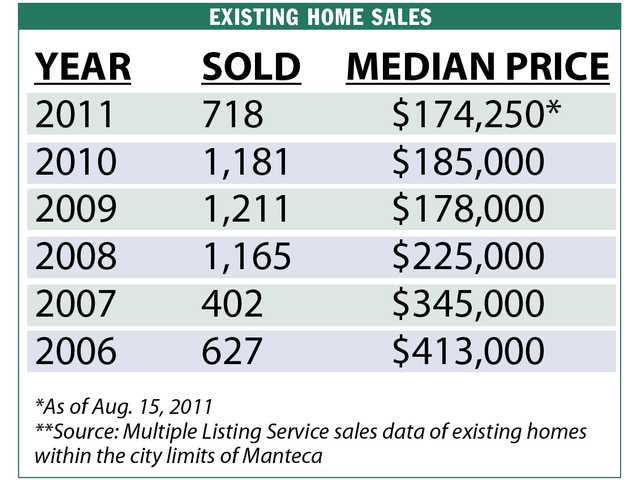
The median selling price movement, though, is close to mirroring that of the rest of the state. California prices were off 6 percent in July compared to July of 2010. The decline in Manteca was 5.8 percent. But unlike the state as a whole, Manteca’s home prices jumped from 2009 to 2010 going from a median of $178,000 to $185,000 while the California median closing price declined.

The number of existing homes closing escrow has remained steady for the past four years. There were 1,165 homes sold in 2008, 1,211 homes in 2009, and 1,181 homes in 2011. As of Monday, 718 homes have been sold this year. That reflects 3.2 homes closing escrow every day. At that rate, Manteca will hit 1,169 sold homes by year’s end.

The pending deals offer encouraging numbers in terms of the median price not slipping. There are 206 homes currently in contract with a median pending price of $186,450.

There are 200 active listings with a median asking price of $194,750. The inventory has been dropping after climbing back up to 268 in February. Prior to the start of this year, the number of available homes had been steadily declining since September 2007 when a record 651 homes were waiting for buyers.

Realtors have indicated it is not clear if the decline is the result of inventory actually dropping or the foreclosure process taking longer to put homes back on the market. In either case, the market absorption of existing homes has remained virtually unchanged since March of 2008.

By Dennis Wyatt
Managing Editor
dwyatt@mantecabulletin.com
209-249-3519